
Mini
A versatile sample browser that doubles as an instrument and sound design tool. VST3 / AU.
Platforms: Windows / macOS / Linux
Overview
2D scatter plot
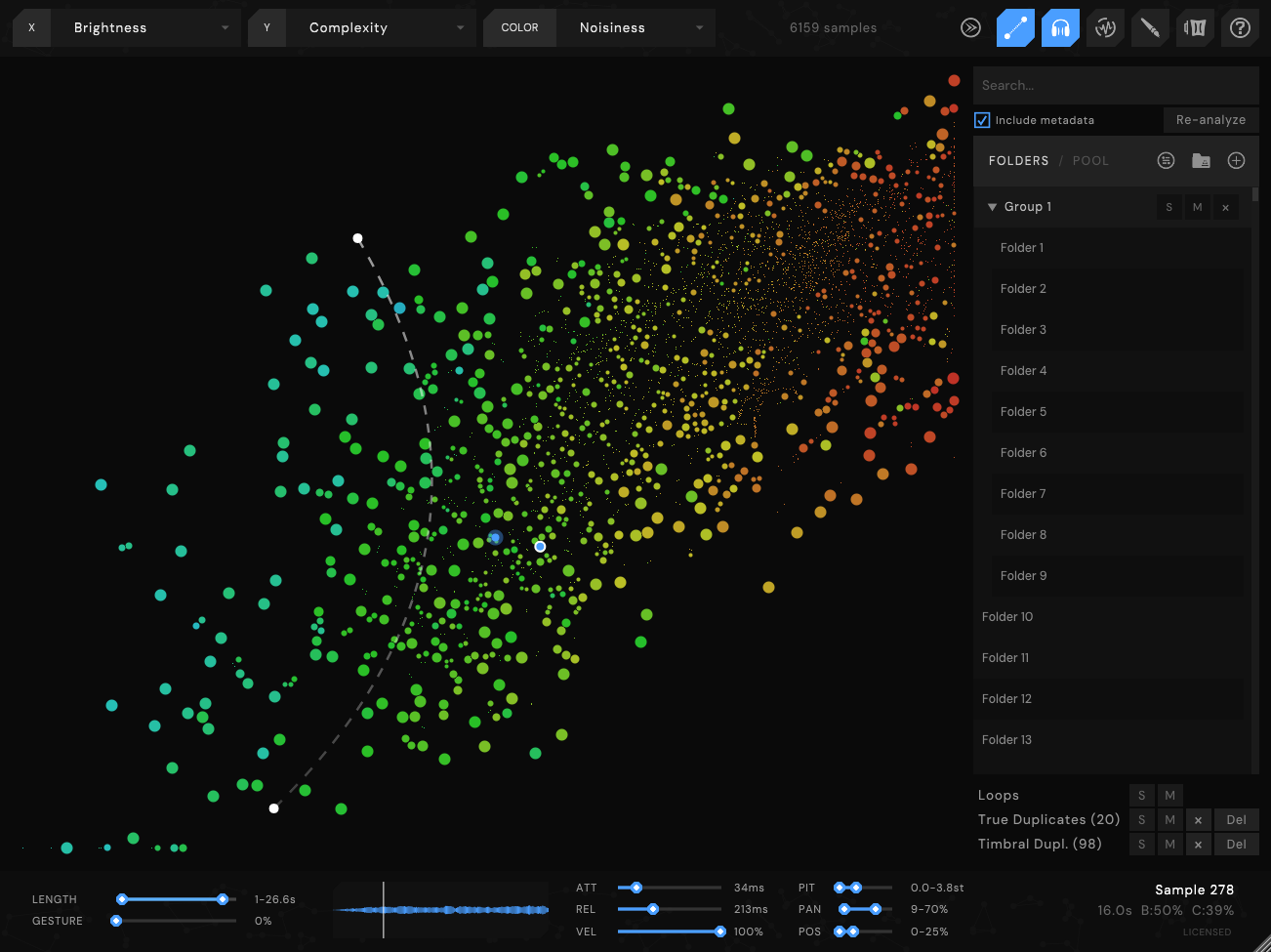
Mini displays loaded samples as colorful dots in a X / Y scatter plot, the position of which is determined by analyzing the samples' sound qualities and distributing them accordingly. The parameters are: brightness, noisiness, complexity, attack, percussiveness, length, loudness, harmonicity, chroma, pitch and pitch focus.
These can also be customized by directly choosing a specific parameter and binding it to the X and Y axes at will.
Hovering over the samples will allow you to play them back instantly.
Gesture recording + MIDI line
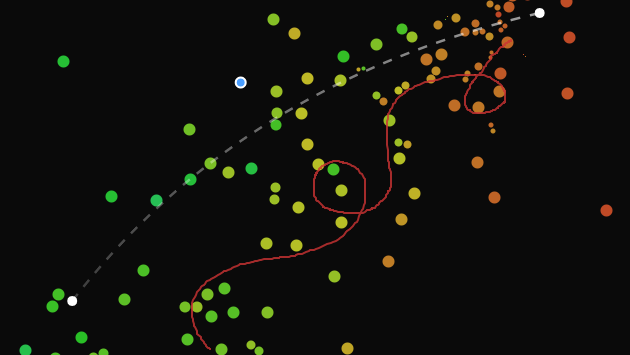
Turn your sample library into an instrument. Gesture recording lets you draw a path across your sample library and play it via automation.
MIDI line maps your samples onto MIDI keys for real-time performance.
Drag & Drop
Once you find a desired sample, drag it to your DAW. Shift+Drag lets you select multiple samples at once.
Polyphonic playback
Adjust attack and release envelopes to activate polyphonic playback and create textures. Randomize pitch/pan/start position per trigger to turn Mini into a sound design tool.
Play in key
Mini analyzes the pitch and harmonicity of your samples, so you can play the whole library in a key three ways: Filter shows only the samples that fit the key, Harmonize retunes each triggered sample onto the key as you play, and Shift transposes the entire map by the note you hold.
Retune samples individually
Alt+Drag any sample up or down to retune it, hold Ctrl to snap to semitones. Shift+Alt+Drag trims its level. Tunings and trims are saved with the project.
Output capture
Record Mini's output straight to disk from the footer, no DAW routing needed. Each take is saved as a WAV clip you can audition and drag back into your DAW.
Handles hundreds of thousands of samples
Mini is constantly optimized for scale. Currently stress-tested to 500k samples loaded at once. Analysis results are cached per-folder, so subsequent loads are quick.
Folder groups, presets, search
Organize your samples into folders and switchable groups that can be triggered via CC and key commands, allowing them to perform in real time.
Filters & Duplicates
Solo / Mute loops, find True duplicates (exact file copies), Timbral duplicates (similar sounds) and delete if needed.
Quick Start
- Open Mini as an instrument plugin in your DAW.
- Click the + button and add samples to the plugin.
- Mini analyzes each sample's characteristics and places it on the X / Y plot.
- Hover over the samples to create textures. Adjust Attack / Release to enable polyphonic playback. Select samples via Shift+Drag and drag them to your DAW.
Interface
Scatter Plot
The central 2D space that maps all visible samples based on X/Y properties. Scroll to zoom, right-click drag to pan, double-click to reset.
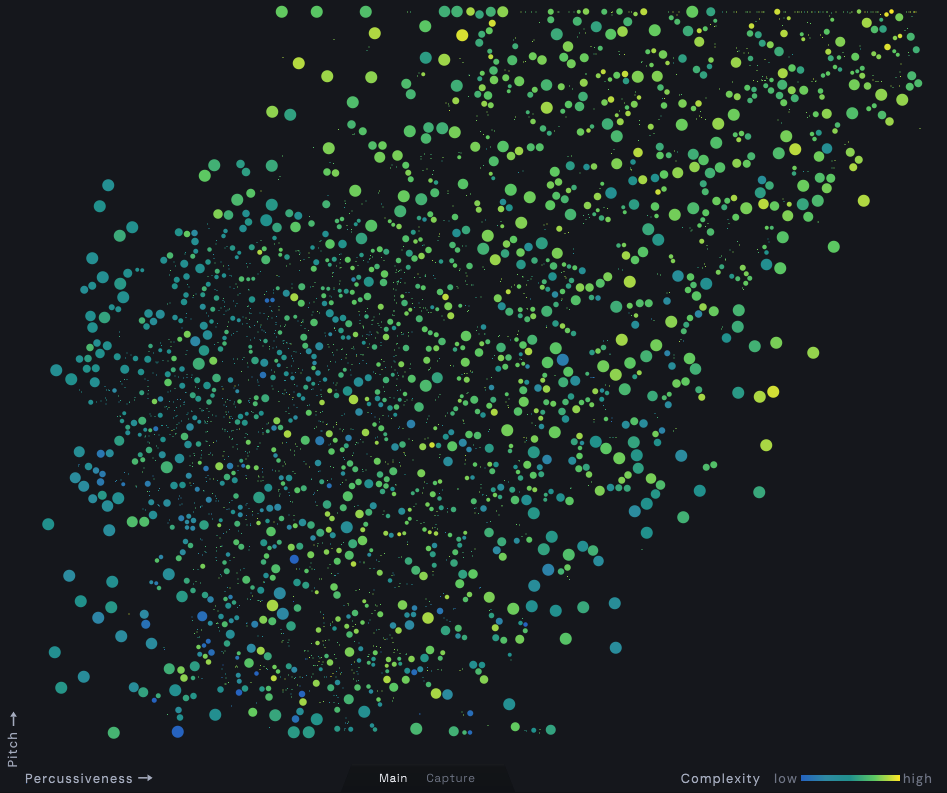
Eleven parameters are available for the X, Y, and color axes:
| Parameter | What it measures |
|---|---|
| Brightness | How bright or dark the sound is |
| Noisiness | Noise-like vs tonal |
| Complexity | Bandwidth and spectral variation of the sound |
| Attack | Onset sharpness - how quickly the sound starts |
| Percussiveness | Transient energy relative to sustain |
| Length | Duration of the sample |
| Loudness | RMS level |
| Harmonicity | How tonal vs noisy the sample is (detects one or several pitches) |
| Chroma | The most prominent pitch class (note), regardless of octave |
| Pitch | Register of the sample - low to high |
| Pitch Focus | How strongly a single pitch dominates the sample |
By default, hovering over the samples in the scatter plot automatically triggers its playback. By utilizing the attack / release parameters for playback and the pitch / pan / sample start randomization parameters, the user can turn mouse gestures into musical results.
Header

- X / Y axis dropdowns - Each dropdown contains analyzed parameters of each sample and lets you organize your samples in the XY space. For instance: brightness on the X axis means that the sounds towards the left side will have an emphasis on low frequencies and the samples towards the right side would be perceptually brighter. If both X and Y axes are set to the same parameter, samples will be organized into a straight line. By combining this with the MIDI line function, you can map samples onto your keyboard organized by brightness, complexity, loudness and more.
- Color dropdown - Choose the parameter colors represent. E.g: Length as color means sounds marked blue would be short and sounds marked red would be 30s+ long.
- Sample count - Number of loaded samples.
- >> button - Hide / show the right panel.
- MIDI Line (Ctrl+Drag) - Toggle to show / hide MIDI line.
- Hover Preview (P) - Toggle hover-to-preview samples.
- Quantize (Q) - Toggle and configure the quantization grid for gesture playback.
- Record (R) - Start / Stop recording a gesture.
- Clear Gesture - Delete the recorded gesture path.
Right Panel
The right panel is reserved for sample library organization, search, presets and pool.
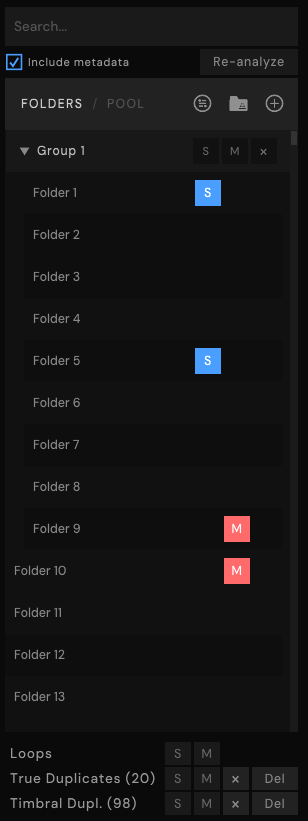
- Search box - Filter samples by filename. Check Include metadata to extend the search. Click re-analyze to re-analyze samples.
- Preset indicator - Shows the active preset name.
- Folders / Pool / Filters tabs - Switch between folder management, the sample pool, and the filters panel.
- Filters panel - Range sliders for every analysis axis, the key and play-mode controls, and the loop / duplicate solo-mute controls, all in one place.
Search & Re-analyze
Search for sounds by their filename. Enable the "Include metadata" checkbox to also search WAV/AIFF metadata tags.
Click Re-analyze (next to the metadata checkbox) to force a re-analysis of all the loaded folders. Useful if the utilized files have changed within the disk.
Filters & Duplicates
The Filters panel gathers every way of narrowing down what's visible in one place: a range slider for each analysis axis (including the pitch axes), the key and play-mode controls (see Pitch & Key), and the loop and duplicate controls.
Drag the handles on any axis range slider to hide samples outside that range - for example, keep only short, bright sounds, or only the strongly-pitched ones.
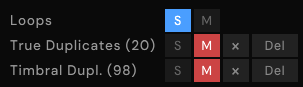
Mini detects two types of duplicates across your loaded folders:
- True duplicates - Identical files, regardless of filename.
- Timbral duplicates - Samples matching within 0.5% on all seven sound qualities. This makes it easy to find samples that are virtually identical but differ slightly in amplitude, length or character.
Loops provide S (Solo) and M (Mute) controls. True duplicates and timbral duplicates provide all four: S (Solo), M (Mute), X (Remove from view — does not delete files), and Del (Move to system Trash with confirmation).
Footer & Controls
The footer contains playback controls and sample information.

- Main / Capture switch - Flip the footer between the map controls and the output-capture console (see Output Capture).
- Length - Filter samples in the scatter plot by duration. Drag the min/max handles. Extend to 30s to include sounds with 30s or longer. (Enable "Remove 30s playback cap" in settings for longer samples if your device has enough RAM.)
- Gesture slider - Scrub through a recorded gesture path.
- X / Y sliders - Directly position the XY cursor on the scatter plot without using the mouse, triggering the sample at that point. They track your mouse while you hover the plot, and drive the same Cursor X / Y automation parameters (CC2 / CC3) - so dragging them can be automated or recorded.
- Waveform display - Waveform of the selected/hovered sample.
- ATT (Attack) - 0-5000ms fade-in, log-scaled.
- REL (Release) - 0-5000ms fade-out. Enables polyphonic layering.
- VEL (Velocity) - 0-100% playback volume. Also responds to MIDI velocity.
- PIT - Random pitch per trigger, up to +/-12 semitones (playback only).
- PAN - Random pan per trigger, up to +/-100% (playback only).
- POS - Random start position per trigger, up to 100% into the sample (playback only).
- Sample info - File name and properties.
The power of Mini lies in polyphonic playback with randomization combined with automation, making it possible to carve out all kinds of sound textures.
Pitch & Key
Mini analyzes the pitch of each sample - its register, its most prominent note (chroma), and how tonal or noisy it is (harmonicity and pitch focus). These become axes and range filters like any other, and they drive Mini's key features.
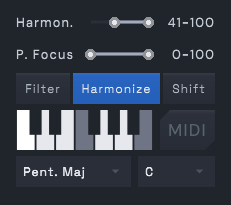
Harmonize and retuning work best when Mini can read a clear pitch. Filtering out low-harmonicity or low pitch-focus samples (via those range filters) keeps ambiguous, noisy sounds out of the way and makes the retuning noticeably more accurate.
Playing in Key
Set a key from the scale and root dropdowns in the Filters panel, build a custom scale, or just play and let the incoming notes set it. Then choose how the library responds:
- Filter - Only the samples that already sit in the key stay visible.
- Harmonize - Each triggered sample is retuned onto the key as you play. Harmonize also corrects fine detuning: an off-key sample is nudged the sub-semitone amount onto the exact pitch, not just to the nearest note.
- Shift - The entire map is transposed up or down by the note you hold.
A MIDI toggle decides what sets the key: when on, the incoming MIDI drives the filtering / harmonization; when off, it follows the key you picked.
Retuning & Levels
Retune any sample individually. Hover a sample and Alt+Drag up or down to change its pitch; hold Ctrl as well (Alt+Ctrl+Drag) to snap to semitones. A live readout shows the offset, and retuned samples are marked on the plot. Alt+double-click resets a sample to its original pitch. To retune several at once, Shift+Drag to select them first, then Alt+Drag. It works on pool samples too.
Trim a sample's level the same way: Shift+Alt+Drag sets a per-sample loudness offset in dB, and Shift+Alt+double-click resets it. Tunings and level trims are saved with the project and per device, and re-apply on load.
Folders & Groups
The Folders tab in the right panel visualizes folder structures and lets you reorder and make your own structures. Click + to add a folder (scanned recursively), or drag folders from your file manager directly into the plugin. Multi-select with Shift+click or Ctrl+click, and drag rows to reorder or nest them.
Each row has S (solo), M (mute) and X buttons. Hovering a folder highlights its samples on the scatter plot grid.
X deletes that folder (or group, or whole tree) and the samples it contains from the plugin — it never deletes the audio files on your disk. Deletions persist: a removed folder stays gone when you reopen the project or relaunch. Drag the folder back in to restore it.
You can also ungroup a group or a folder by right-clicking it and choosing Ungroup.
Select multiple folders and press Ctrl+G to group them. Groups can be collapsed, soloed/muted as a unit, as well as renamed, or deleted. Use Ctrl+0 to clear all group solos, or Ctrl+1 through 9 to solo a specific group. Folder/group solo & mute and the folder layout are saved per project instance.
Presets
Click the preset button to open the preset manager. Save, rename (R), or delete (X) presets. Presets store the folder layout: folder paths, groups, the tree structure (drop roots, collapse and reorder state), and per-folder and per-group solo/mute. Plot settings such as axes and filters are not part of a preset.
Use "Save as Default" to set the current configuration as the default for new instances.
Sample Pool
The pool is a temporary area for collecting samples before doing a batch Drag&Drop. Hover or select a sample and press A to add/remove it. Shift+Drag to select multiple samples, then A to batch add. You can also drag samples from the plot onto the right panel.
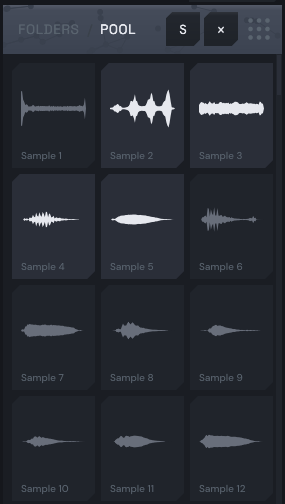
The Pool tab shows collected samples as a tile grid with waveform previews. Click to preview, X to remove, drag to reorder. Use the grip icon (9-dot icon) to drag all pool samples to your DAW at once.
When the Pool tab is active, pool samples are highlighted on the scatter plot with white ring indicators.
Playback
Press P to toggle hover preview on/off - samples play automatically as you move over them. Loops play continuously on hover. Mini supports 64-voice polyphony. When a MIDI line is drawn, MIDI notes trigger samples along the line based on note number.
Notes you play from a MIDI keyboard use the same attack and release envelopes as hover playback, so they can layer polyphonically. Mini also responds to the sustain pedal (CC64) and to pitch-bend, with a bend range you can set in the settings.
MIDI Line
Ctrl+Drag on the scatter plot creates a MIDI line between two points, mapping samples to the keyboard. Toggle visibility with the MIDI Line button in the header.
Gesture Recording
Press R to start recording, then move your mouse across the scatter plot. Press R again to stop. Use the gesture slider or CC1 to scrub through the recorded path, triggering samples along it. Clear with the trash icon.
Quantization
Press Q to toggle quantization. Gesture playback, the hover preview, and the cursor (automation / CC / scrubbing) each have their own grid, so you can snap them independently. Choose a subdivision (1/1 through 1/32, plus triplet variants) and triggers land on the DAW's tempo grid.
Gesture Sync locks gesture playback to the host tempo - one pass of the gesture spans 1, 2, 4, or 8 bars.
Output Capture
Record whatever Mini is playing straight to disk, without routing it through your DAW. The Main / Capture switch in the footer flips between the map and the capture console.

- Press C (or hit REC) to start and stop. Each take is written to disk as a WAV.
- Takes show up as clips. Click one to audition it, or drag it straight into your DAW or file manager.
- Clear wipes the takes.
Favorites
Press F while hovering over or selecting a sample to put it in your favourites. Use Shift+Drag to select multiple, then F to batch-favourite. Favorites are saved per-device and persist across sessions. Use the filter section's solo/mute controls to quickly isolate your marked samples.
Drag & Drop
Examples:- Drag into DAW - Drag a dot from the scatter plot into your DAW.
- Export pool - Use the 9-dot pattern in the Pool tab to drag all pooled samples at once.
- Import folders - Drag a folder from your file manager into the plugin to add it as a source.
Exported files are always the original, unmodified audio - randomization settings are not exported.
Keyboard Shortcuts
| Key | Action |
|---|---|
| P | Toggle hover preview |
| Q | Toggle quantization |
| R | Toggle gesture recording |
| F | Toggle favorite on hovered/selected sample |
| A | Add/remove hovered/selected sample to pool |
| C | Start / stop output capture |
| L | Reveal the hovered sample's folder |
| Ctrl+G | Group selected folders |
| Ctrl+C | Copy selected sample's file path |
| Ctrl+Drag | Draw MIDI line on scatter plot |
| Shift+Drag | Multi-select samples (rubber band) |
| Alt+Drag | Retune hovered / selected sample |
| Alt+Ctrl+Drag | Retune, snapped to semitones |
| Shift+Alt+Drag | Set per-sample level (dB) |
| Drag out | Export sample to DAW |
| Scroll | Zoom scatter plot |
| Right+Drag | Pan scatter plot |
| Double-click | Reset zoom |
| Escape | Dismiss active MIDI line |
| Home | Reset zoom to 1x |
| Ctrl+V | Paste folder/file paths from clipboard |
| Ctrl+0 | Clear all group solos |
| Ctrl+1-9 | Solo group 1-9 |
External Control
By default, Mini exposes automation parameters that can be hooked to external controls:
- Line Start X / Y, Line End X / Y, Line Curve - Controls MIDI Line endpoints and curvature.
- Gesture Position - Making it possible to automate current position inside of a gesture.
- Attack / Release - Adjusting polyphonic playback envelope.
- Random Pitch / Pan / Pos Min / Max.
- Cursor X / Y - Simulate the same action as mouse hover over the X/Y scatter plot. Hooking these parameters to external devices (such as motion tracker / LFO / Envelope follower / CV) opens up a world of possibilities.
- Velocity - Adjust overall playback amplitude. This also affects overall MIDI input velocity.
- X / Y / Color axes - The three scatter-plot axes are automatable, so the whole layout can change over time.
- Quantize grids & Gesture Sync - The three quantize grids and the gesture tempo lock are automatable too.
Moreover, Mini provides additional control via these CC parameters:
| CC | Function |
|---|---|
| CC1 | Gesture position - scrubs through recorded gesture path |
| CC2 | Cursor X - moves the XY cursor horizontally |
| CC3 | Cursor Y - moves the XY cursor vertically |
| CC4 | Group solo - 0 clears all solos, 1-127 exclusive-solos that group |
| CC5 | Key scale - selects the scale used for Filter / Harmonize / Shift |
| CC6 | Key root - selects the root note |
| CC20-23 | The three quantize grids (Gesture, Hover, Cursor) and Gesture Sync |
The XY cursor (CC2/CC3) also works without the editor open, enabling headless sample triggering from a MIDI controller.
Settings
Open the help overlay (? button) to access the following settings:
- Mouse to Automation - By turning it on, every mouse movement is hooked to two automation parameters, making it possible to record a performance by moving the mouse within the scatter plot, gesticulating the automation directly.
- XY scrub mode - Remaps the X/Y cursor so that samples are evenly distributed across the entire CC/slider range. Without it, densely-clustered samples can share a narrow slice of the range. Scrub mode also attempts to prevent flickering between adjacent samples.
- Remove 30s playback cap - By default, audio for playback is loaded up to 30 seconds. Enable this to load the full duration of longer samples for playback.
- Force Mono - New triggers cut the previous voice with a fast click-free fade, so moving across the plot plays one sample at a time instead of stacking voices - handy with long release times.
- Cursor leave preview - Moving the cursor off the scatter plot triggers a preview of the last hovered sample.
- Disable auto loop - Samples detected as loops stop looping on playback and play through once, like any other sample.
- MIDI line variation - When enabled, consecutive MIDI note triggers cycle through nearby samples instead of always picking the nearest one. The pool is limited to samples close to the target position and resets once exhausted. Saved per-project only.
- Color scheme - Choose how the color axis is painted from nine built-in palettes (Original, Blue-Magenta, Viridis, Monochrome, Cividis, Magma, Crimson Mono, Cool, Grayscale) or paste your own gradient. You can also open this by clicking the color legend on the plot. Each option previews its gradient, and your choice is saved per-device.
- Pitch-bend range - Sets how many semitones incoming MIDI pitch-bend moves playback.
- Avoid silent start positions - Skip silent sample start on sample playback.
- Small dots threshold - Threshold above which samples are rendered as dots, significantly increasing performance. Low threshold results in better performance. 0 / 20k / 50k / 100k / 200k / 500k. Setting is saved per-device.
State Persistence
Global / Per-device
Shared across all DAW projects:
- Default folder configuration (via Save as Default)
- Analysis cache (per-folder)
- Favorites
- UI scale
- Presets
- Small dots threshold
- Color scheme
- Sample tunings and level trims (per device, per sample)
- Help-overlay toggles: Remove 30s playback cap, Cursor leave preview, Force Mono, Disable auto loop (Force Mono and Disable auto loop are also saved with each project)
Per-project / Per-instance
Saved with your DAW project, independent per plugin instance:
- Loaded folders, groups and tree layout (including folder X-deletions)
- Solo/mute states
- Recorded gesture and MIDI line
- Cursor X / Y position
- Axis selections (X, Y, color)
- Length and axis filter ranges
- Key, root, scale and play mode (Filter / Harmonize / Shift)
- Quantization grids and Gesture Sync
- Envelope, velocity, and randomization values
- Sample tunings and level trims
- Hover preview, XY scrub mode, Mouse to Automation and MIDI line variation toggles
- Right panel open/close state
- Search text and filter states
- Pool contents